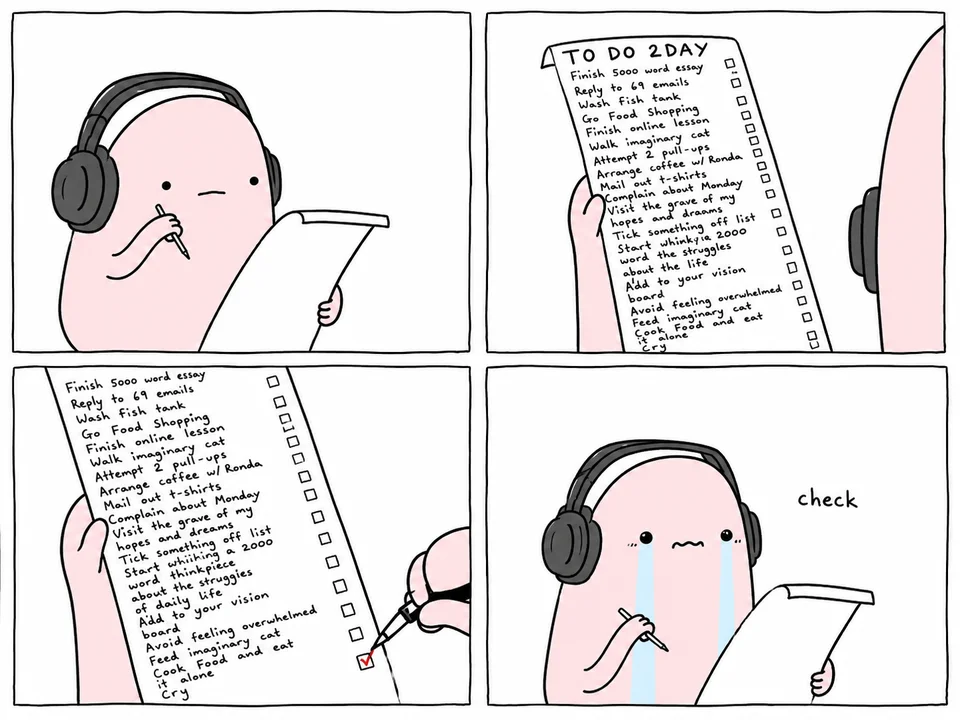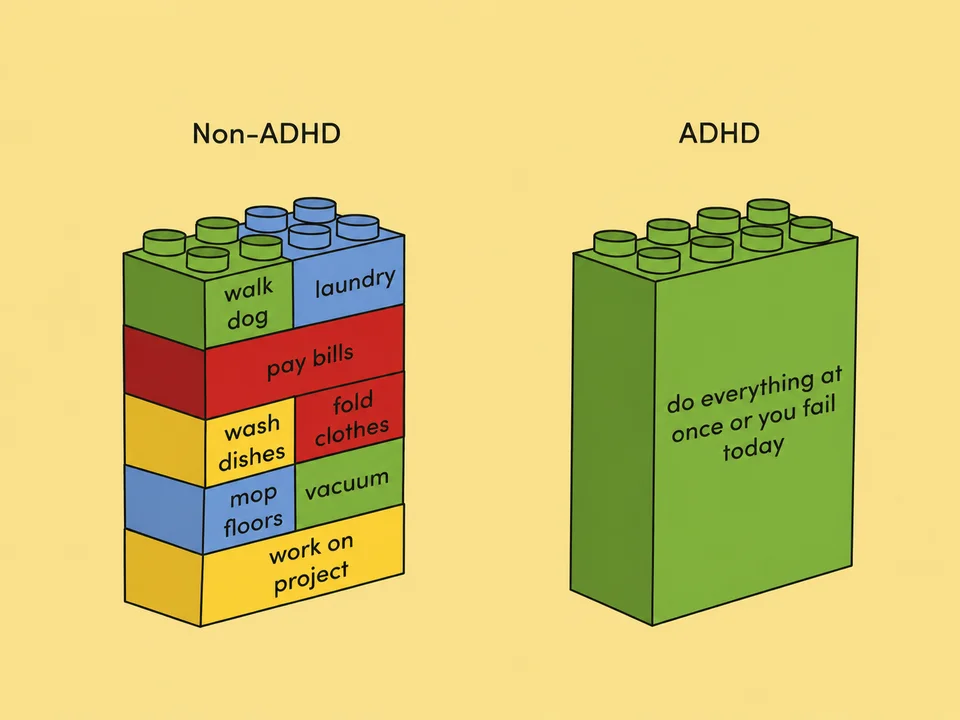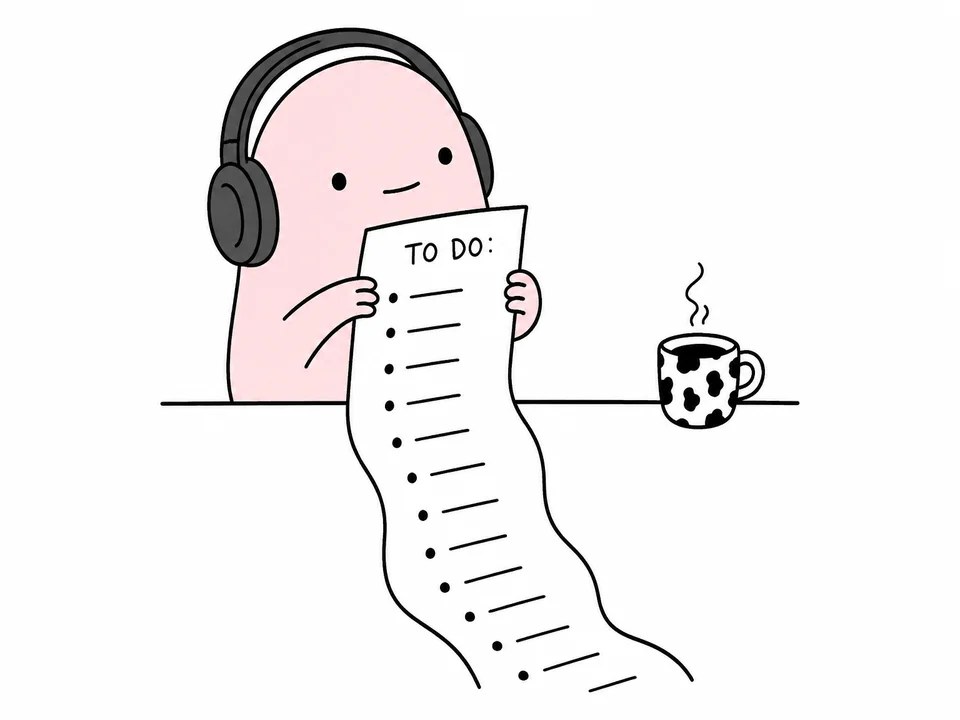
41% of tasks on the average to-do list never get done — and it's not a discipline problem. The format of a long list works against our psychology: the more tasks in front of you, the harder it is to start any of them. Most productivity apps make this worse, not better.
Why Your To-Do List Works Against You
Here are numbers that surprised me: 41% of tasks in the average list never get completed, and the average lifespan of an unfinished task is 22 days. Meanwhile, 82% of people have no structured task management system at all.
One might think: "Well, those people just lack discipline." But here's the thing — people who do have a system often don't fare much better. The list exists, the app is installed, the subscription is paid, tags are assigned — and things still don't get done. The problem isn't character; it's how the tool itself is designed.
What Happens in Your Head When You Open the List
Picture this: it's morning, you sit down to work and open your task manager. There are 30 tasks, maybe 50. You start scanning — and your brain does an enormous amount of work in that moment: evaluating each item for urgency, importance, time required, and your current energy level.
This is called decision fatigue. Psychologist Roy Baumeister demonstrated that the ability to make decisions is a finite resource depleted with each choice, like a muscle. When it tires out, the brain looks for the path of least resistance — and the easiest path is to do nothing at all.
That's exactly why after ten minutes of scrolling your list, you find yourself on Instagram. You didn't get distracted — you escaped, because your brain spent all its resources on choosing, leaving nothing for actually working.
The Paradox of Choice: Why More Means Worse
Psychologist Barry Schwartz showed that the more options available, the harder it is to choose — and the worse we feel afterward. In a store, people buy less jam when faced with 30 varieties than when offered just six. In a task manager, it plays out differently: the person doesn't start working at all.
When you're looking at a list of 40 tasks, your brain gets trapped. Starting with an easy one feels irresponsible. Starting with a hard one is scary. Starting with an urgent one — but what if you miss something important? The brain ends up doing nothing — or worse, starts rearranging tasks between folders, recoloring tags, creating new categories. The imitation of productivity with none of the actual work.
Three Types of Paralysis a Long List Creates
For a long time I thought procrastination was laziness. Research shows something different: it's a self-regulation failure — an inability to manage the negative emotions a task provokes. Not time, but emotions.
When a task feels like a threat (risk of failure, fear of judgment, uncertainty), the amygdala activates — the brain structure responsible for the "fight or flight" response. It releases stress hormones that suppress the prefrontal cortex — the part responsible for planning and initiating action. In plain terms: stress literally blocks your ability to start.
This creates three types of paralysis. Mental paralysis — you open the list and your mind goes foggy; you see words, but they don't translate into action. Task paralysis — instead of writing the report, you start tidying your desk, organizing cables, or going through email. Choice paralysis — you rewrite the list over and over, shift priorities, move tasks between projects. That is procrastination in its purest form, disguised as planning.
The Zeigarnik Effect: Why Unfinished Tasks Clutter Your Thinking
In 1927, Soviet psychologist Bluma Zeigarnik noticed something strange: waiters in a café remembered all open orders perfectly, but immediately forgot the ones already paid for.
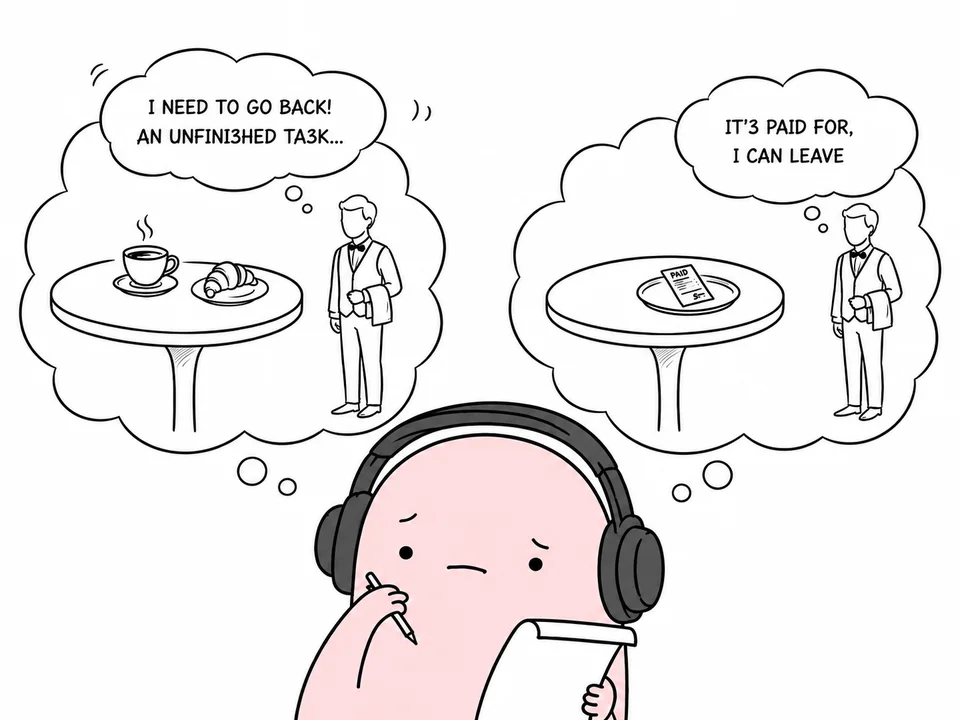
The brain keeps unfinished tasks in active memory — literally taking up RAM. Every item on your list is an open browser tab. With 50 tabs open, the browser slows to a crawl. Long task lists don't free up mental space — they consume it. Every time you open the app, every unfinished item reminds you it's still there, and instead of feeling in control, you feel a low hum of guilt.
Why Most Task Manager Designs Make Things Worse
Productivity app developers borrowed their interface patterns from social networks. An infinite scroll of tasks is a direct copy of a news feed. On Instagram, this design works: the brain gets dopamine from novelty. In a task manager, there's no novelty — you scroll down and see only confirmation of your own inefficiency.
Eye-tracking research shows that when working with long lists, people don't read — they scan diagonally, looking for visual anchors. This surface scanning depletes attention without any result: you spend energy, accomplish nothing, and leave feeling like you've wasted time.
What Your Brain Actually Needs
Your brain doesn't need a perfectly structured list with tags, priorities, and deadlines. It needs an answer to one simple question: what should I do right now?
British researcher Mark Forster came up with an elegant algorithm for this — FVP (Final Version Perfected). Its key insight is replacing "What do I have to do?" with "What do I want to do more than this?" It sounds like a small change, but the difference is fundamental: "have to" activates stress, "want to" removes it. The brain treats the second question not as a threat, but as an expression of its own will — and the block lifts.
The mechanics are simple: take the first task on the list and move downward. For each subsequent task, ask: "Do I want to do this more than the previous one?" If yes — mark it, if no — skip it. The result is a small chain of tasks chosen by readiness, not obligation. You start with the last one — the most desired — build momentum, and ride that wave back to the first, most challenging task.
Why This Works Where GTD Doesn't
GTD — David Allen's legendary system — is built on strict logic: contexts, projects, weekly reviews. For capturing and organizing information, it's excellent. But it has a weakness: it requires analytical work before any action can begin. Under stress or procrastination, that becomes an insurmountable barrier — when your brain is blocked, the last thing it needs is another layer of categorization.
FVP requires nothing more than an honest answer to one comparative question. That's precisely why it works especially well in the moments when conventional systems break down.
How This Looks in Practice with Maybe
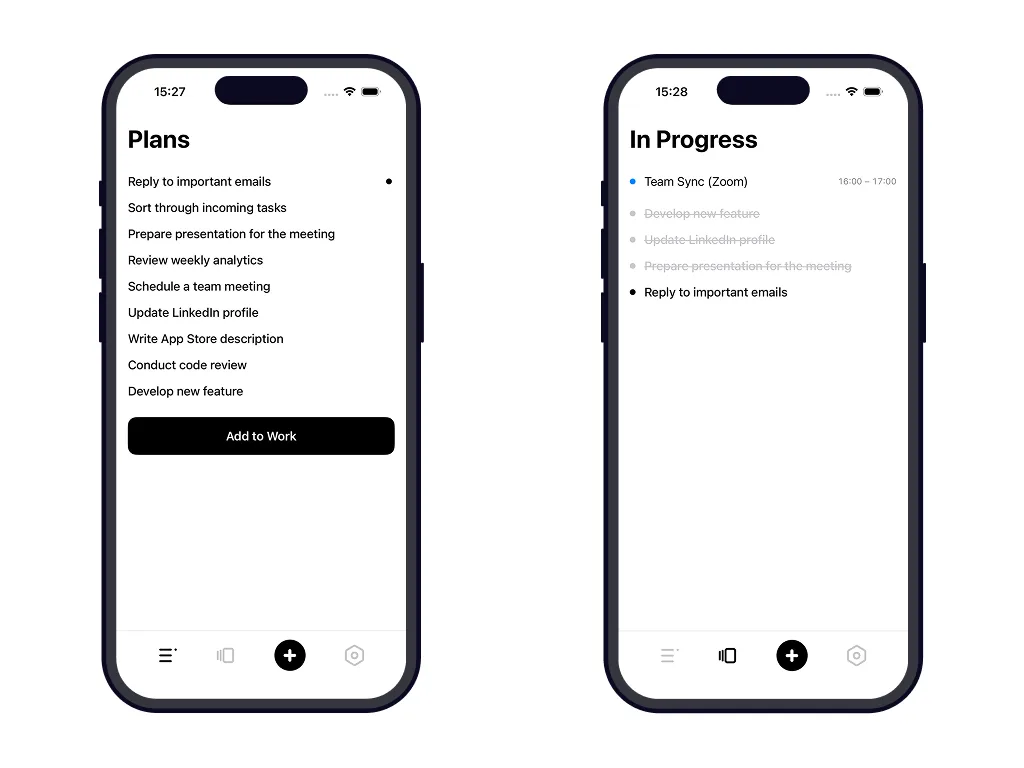
Maybe is built on exactly this idea. It hides the full task list from you while you're working — you simply don't see it. There's only one selection mode through binary comparison of two tasks, and a work mode where you see five items at most. No scrolling through the graveyard.
There's also a completion ritual: when you close a chain of tasks, the app responds with haptic feedback and a sound — the same one Apple Pay uses for a successful payment. The brain receives sensory confirmation of success, releases dopamine, and learns that finishing tasks feels good. Over time, this genuinely changes how you relate to work.
In Summary
The productivity problem I struggled with for years turned out not to be about character or willpower. I was using a tool designed in direct opposition to how my brain works, and wondering why nothing was getting done. A long list is demotivating — that's neuroscience. Scrolling through unfinished tasks causes stress — that's physiology. Paralysis in front of 50 options is a predictable response to overload, not weakness. And if the problem is in the tool, then changing the tool is a perfectly real solution.
Frequently Asked Questions
Why do I procrastinate even when I have a task list?
Procrastination isn't laziness — it's a self-regulation failure. A long task list overloads the brain with choices, triggers a stress response, and literally blocks the ability to start working. The issue isn't discipline; it's that a large list contradicts the psychology of decision-making.
What is the Zeigarnik Effect and how does it affect productivity?
The Zeigarnik Effect is a psychological phenomenon from 1927: unfinished tasks stay in active memory while completed ones are quickly forgotten. In practice, a large list of unfinished items creates constant background stress and reduces your ability to concentrate on current work.
How is the FVP method different from a regular task list?
A regular list requires willpower — you pick "the most important thing" and force yourself to do it. FVP (Final Version Perfected) removes that resistance through a single question: "Do I want to do this more than the previous task?" You always work on what you're most drawn to right now, which reduces stress and makes starting far more likely.
How does Maybe implement the FVP method?
Maybe hides the full task list while you work, showing only a binary comparison of two tasks during selection, and a maximum of five items in work mode. This eliminates choice paralysis and removes visual noise. The completion ritual with haptic feedback reinforces a positive habit around working through tasks.
Maybe is built specifically around the FVP method: instead of manually sorting priorities, the app guides you through a binary task comparison and builds your day's chain automatically. The full list stays hidden while you work — only what you chose, nothing extra.